Table of Contents
- Why a Dazzling Roofline Display Matters in Knoxville
- Designing a Flawless Roofline Lighting Plan
- How to Measure and Get the Right Materials
- Safe Installation: Step-by-Step
- Automating Your Lights with Smart Technology
- Knowing When to Call a Professional Installer
- Common Questions About Roofline Light Installation
Imagine a crisp Knoxville evening. Your home is glowing, outlined with perfectly straight, brilliant Christmas lights on the roofline. It’s a classic holiday image, but getting there often involves a mess of tangled wires, a wobbly ladder, and a finished product that just doesn't quite capture the magic you envisioned. If you're tired of the annual struggle, you're in the right place.
This guide is for every homeowner, event planner, or small business owner in Farragut or Hardin Valley who dreams of a stunning, professional-looking display without the usual holiday stress. We'll walk you through a proven, solution-focused process, covering everything from design ideas to safe, secure installation. Our goal is to make your home a festive landmark this season, turning that frustrating task into a rewarding project.
Forget the tangled mess. We're here with clear, expert advice to help you master installing Christmas lights on a roofline and create a display that brings you joy all season long.
Why a Dazzling Roofline Display Matters in Knoxville
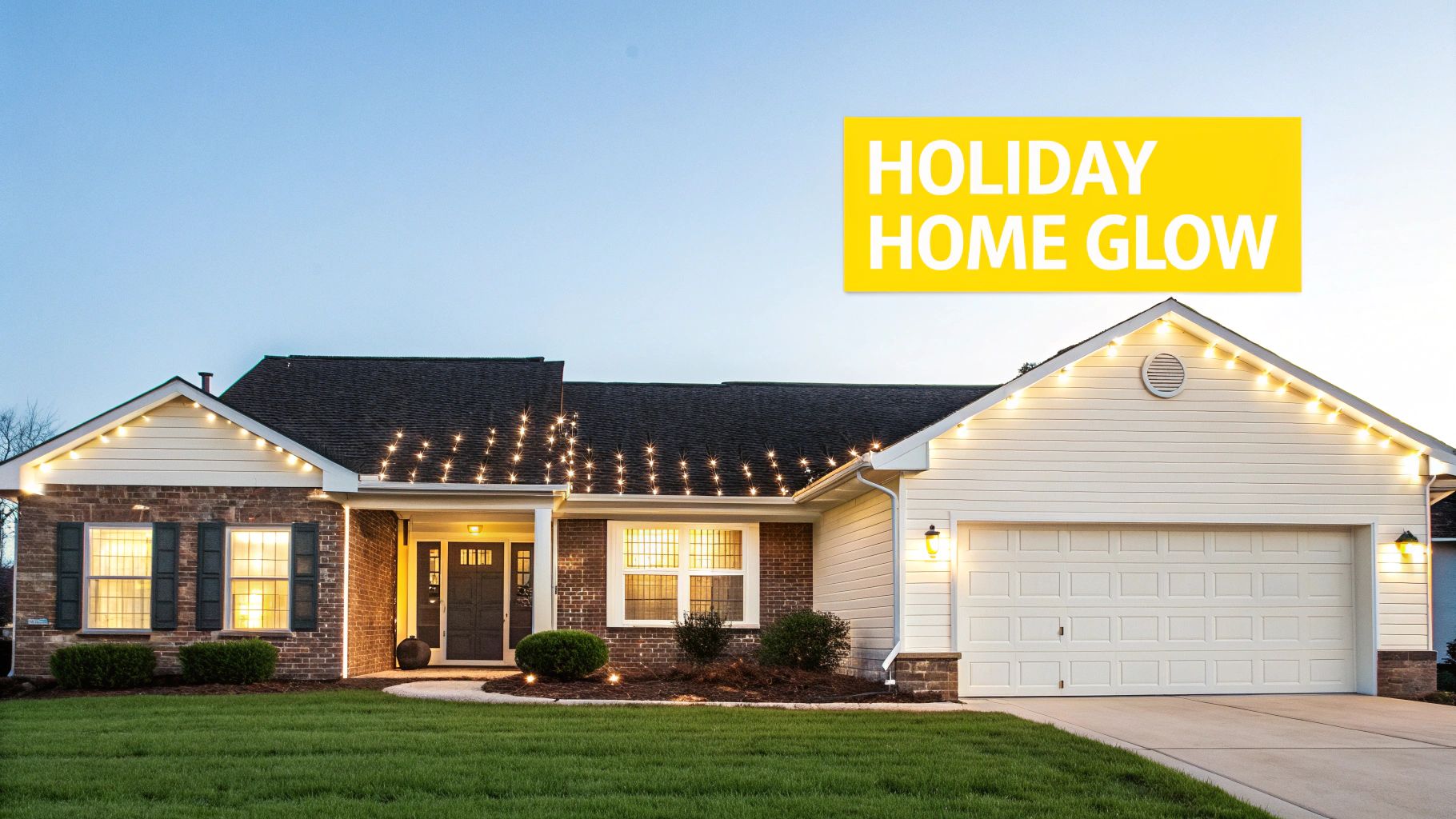
A well-executed roofline display is more than just a nod to the holidays. It dramatically boosts your home's curb appeal, creates a warm, welcoming vibe for guests, and can even become a cherished tradition for your entire neighborhood. A clean, bright roofline defines your home’s architecture, giving it a polished, intentional look that stands out.
This is especially true with the diverse home styles across East Tennessee. Whether you're highlighting the classic brick of a West Knoxville home or the sharp, modern lines of a new build in Hardin Valley, the right lighting plan makes all the difference. It turns your home from just another house on the block into a true holiday showpiece.
What This Guide Covers
We’ve designed this guide to give you the confidence to tackle your lighting project from start to finish. Inside, you'll find practical, skimmable advice on:
- Planning and Design: How to choose bulb types and color schemes that complement your home's unique style.
- Measuring and Materials: The right way to calculate what you need to avoid last-minute trips to the store.
- Safe Installation: A step-by-step process that puts safety first while delivering professional results.
- Smart Technology: Tips for automating your display for total convenience and efficiency.
Let's get started on making your home the highlight of the neighborhood. And if you decide you'd rather have a completely hands-off experience, you can always explore our professional 𝑖𝑛𝑠𝑒𝑟𝑡𝑙𝑖𝑛𝑘𝑡𝑜𝐶ℎ𝑟𝑖𝑠𝑡𝑚𝑎𝑠𝑙𝑖𝑔ℎ𝑡𝑠𝑝𝑎𝑔𝑒.
Designing a Flawless Roofline Lighting Plan
A truly show-stopping holiday display starts long before you pull out the ladder. The most impressive Christmas lights on a roofline come from smart planning, where your vision meets the practical realities of your home's architecture. This is where you map out a design that not only looks incredible but is also safe and straightforward to install.
First, take a good look at your home’s unique character. A classic brick home in a neighborhood like Sequoyah Hills might look stunning with timeless warm white lights. On the other hand, a contemporary new build in Hardin Valley could be the perfect canvas for a vibrant, multi-color display.
Your personal style is just as crucial. Are you aiming for a clean, elegant look or something more fun and festive? Answering that question will steer every other decision, from the bulbs you choose to the colors you feature.
Choosing Your Bulb Style and Color Scheme
The type of bulb you pick has a massive impact on the final look and feel of your display. Different bulbs create entirely different moods. It's all about the aesthetic you want to create.
- C9 Bulbs: These are the large, classic "strawberry" shaped bulbs that deliver a bold, nostalgic glow. They create a high-impact outline that’s impossible to miss from down the street.
- C7 Bulbs: A slightly smaller version of the C9, these offer a more delicate but still traditional look. We find they’re great for smaller homes or for highlighting specific details like dormers.
- Mini Lights (5mm): These small but mighty lights create a brilliant, twinkling effect. While often used on trees, they can create a sharp, modern line along a roof when spaced closely.
Once you’ve landed on a bulb, it's time for the fun part: picking colors. You can’t go wrong with classic warm white for a sophisticated feel or multi-color for pure holiday joy. For a more curated look, consider a two-color theme, like red and white or blue and white, that plays well with your home’s exterior paint and trim.
Pro Tip: Before you commit, buy a single short strand of your chosen lights. Plug them in one evening and hold them up against your home. Seeing how the color and brightness actually look with your siding or brick can save you from buying hundreds of feet of the wrong lights.
The trend of creating dazzling home displays is growing. Globally, the Christmas lights market is projected to grow from an estimated $8.39 billion in 2025 to around $11.3 billion by 2033. Much of this growth comes from better LED technology, which makes large outdoor displays more energy-efficient and durable for homeowners like you.
Choosing the Right Bulb for Your Knoxville Home
The architecture of many Knoxville-area homes lends itself to different styles, from stately traditional to sleek modern. This table breaks down which bulb works best for different scenarios.
| Bulb Type | Best For | Brightness | Energy Use | Knoxville Style Match |
|---|---|---|---|---|
| C9 LED | Creating bold, traditional outlines on larger homes; high rooflines. | High | Low | Perfect for classic homes in Farragut or Bearden. |
| C7 LED | Accenting architectural details like gables and dormers; smaller homes. | Medium | Very Low | A great fit for historic homes or charming bungalows. |
| Mini LED (5mm) | A sharp, modern look; tightly wrapped columns or railings. | Bright & Focused | Very Low | Complements contemporary builds in Northshore. |
Ultimately, the best bulb is the one that brings your specific holiday vision to life while highlighting the best features of your home.
Sketching Your Vision and Planning for Power
You don’t need to be an artist. Just grab paper and sketch a simple outline of your house. Mark all the spots you want to light—gables, dormers, eaves, and the porch line.
Next, walk around your property and locate all your outdoor electrical outlets, marking those on your sketch. This simple map is a game-changer. It helps you decide where to start, how many extension cords you'll need, and the best way to run them discreetly.
This plan isn't just about looks; it's a critical safety step that helps you avoid overloading a single circuit. A good rule of thumb is to distribute your light strands across multiple outlets on different circuits whenever possible. And always plug outdoor lights into a Ground Fault Circuit Interrupter (GFCI) outlet. It’s designed to shut off the power instantly if it detects a problem, protecting you and your family from electric shock.
Getting your roofline right is a fantastic start, but you can create even more "wow" factor by lighting other parts of your property. To learn more, check out our complete guide to roofline, tree, and yard lighting strategies.
How to Measure and Get the Right Materials
There’s nothing worse than getting halfway through an installation only to realize you’re a strand or two short. Taking the time to get accurate measurements is the foundation of a clean, professional-looking display and saves you from maddening, last-minute trips to the hardware store.
The good news? You can get a solid estimate without spending hours teetering on a ladder.
For a simple roofline, a rolling measuring wheel is your best friend. Just walk the perimeter of your house to get a precise linear footage in minutes. If you don't have one, you can use the measurement tool on Google Maps’ satellite view. It's a surprisingly effective trick for tracing your roofline right from your computer.
Just remember to account for every peak and valley. Those gables, dormers, and eaves add more length than you might think.
Accounting for Architectural Details
Most homes here in Knoxville aren't simple boxes, and those unique features are what make a lighting display pop. To ensure you have enough lights, here’s what to do:
- Gables and Peaks: Measure the horizontal length of the gable, then measure the angled height from the eave up to the peak. You must account for both slopes, not just the flat base width.
- Dormers: Carefully measure the front and sides of every dormer you plan to light.
- Eaves and Overhangs: Don't forget these! They add up quickly, so include them in your total linear footage.
Once you have your individual measurements, add them up. Then—and this is important—add an extra 10% to your grand total. This buffer covers any small miscalculations and gives you the slack needed to run cords neatly to your power source.
Pro Tip: Before you buy anything, measure the distance from where you plan to start your lights to the nearest GFCI outlet. That number tells you exactly how long of an extension cord you’ll need.
Building Your Complete Shopping List
With your measurements locked in, you can build a shopping list that goes beyond just the lights. Getting every component you need in one go makes the installation process much smoother. For Knoxville’s unpredictable winter weather—which can swing from freezing rain to gusty winds—high-quality, weather-resistant materials are non-negotiable.
Here’s your essential shopping list:
- Light Strands: The total linear feet you calculated, plus that crucial 10% buffer.
- The Right Clips: This is critical. Use shingle tabs for asphalt shingles and all-in-one or gutter clips for gutters. Never use nails or staples, as they cause permanent damage. Plan on one clip for every bulb (or every 6-8 inches) to prevent sagging.
- Heavy-Duty Outdoor Extension Cords: Ensure they are rated for outdoor use and are long enough to reach your outlets without being pulled tight.
- Outdoor Timer or Smart Plug: A simple timer automates your display, saving energy and hassle. A smart plug gives you even more control from your phone.
- Extra Fuses and Bulbs: Even with durable LEDs, it’s smart to have a few replacements ready.
Choosing the right type of light is just as important as measuring correctly. For a deep dive into the different options, check out our guide on the best outdoor Christmas lights. Investing in quality from the start means your display won't just look great—it'll last for the whole season and for many more to come.
Safe Installation: Step-by-Step
Alright, you've got your design dialed in and a pile of lights ready to go. Now for the fun part: bringing that vision to life. This is where the real work begins, and putting safety first is the only way to keep your holiday season merry. A solid installation doesn't just look better—it protects your home and everyone in it.
Before you touch that ladder, prep your work area. Clear the ground below your roofline of anything you could trip on—garden hoses, tools, or toys. You need a clean, stable area for your ladder so you can focus on what's above you.
Ladder Safety Is Non-Negotiable
I can't stress this enough. Every year, people get hurt falling off ladders while decorating. Don't become a statistic. Treating your ladder with respect is absolutely critical for installing Christmas lights on the roofline safely.
- Inspect Your Ladder: Before you climb, check it. Are the rungs solid? Are the feet stable? Any dents or cracks? If it looks sketchy, don't use it.
- Find Solid Ground: Plant your ladder on a firm, level surface. Stay away from soggy grass or uneven spots that could let the ladder shift.
- Bring a Spotter: This is a two-person job. Ask a family member or friend to hold the base of the ladder steady. Their only job is to ensure it doesn't wobble while you're up there.
- Keep Three Points of Contact: This is the golden rule. As you climb and work, always keep two feet and one hand, or one foot and two hands, on the ladder. It makes a massive difference in stability.
Prep on the Ground for a Perfect Look Up High
One of the most frustrating mistakes is hanging an entire string of lights, stepping back, and then spotting a dead bulb right in the middle. The good news? It's completely avoidable.
Before you hang a single light, plug every strand in on the ground to make sure every bulb is shining. This is also the perfect time to attach your clips. Lay the light string out and attach a clip to every bulb (or about every 6-8 inches). This prep work guarantees even spacing and ruler-straight lines once they're on the roof. Fumbling with clips while perched on a ladder is awkward, slow, and unsafe.
Pro Techniques for a Flawless Finish
With your lights tested and your ladder secure, you're ready to start. For the cleanest look, always begin your installation near your power source and work away from it. This prevents you from ending up with a wad of extra lights or an ugly extension cord dangling down the side of your house.
As you move along the roofline, pull the light strand taut before locking in each clip. That tension is the secret to avoiding that droopy, sad-looking sag. A straight, crisp line of light makes your home's architecture pop.
Crucial Installation Tip: Never use staples or nails to attach your lights. Putting holes in your shingles or fascia is asking for trouble—water damage, leaks, and you could even void your roof's warranty. The right plastic clips hold lights securely without harming your home.
When you get to corners or peaks, the goal is a sharp, defined transition.
- For Outside Corners: Pull the strand tight and place one clip right before the corner and another immediately after it. This will give you that perfect 90-degree angle.
- For Gables and Peaks: Run the lights to the very top. Secure a clip on each side of the peak to hold that top bulb firmly in place, then continue your run down the other side.
Finally, do one last check from the street. Look for any sags, crooked bulbs, or loose spots. It's much easier to make small adjustments now than after a windy Knoxville night knocks things out of place.
Automating Your Lights with Smart Technology
Once your Christmas lights on the roofline are perfectly installed, the last thing you want is to run outside in the cold Knoxville rain every night just to plug them in. Modern tech offers a much smarter way to manage your display, adding convenience, saving energy, and unlocking cool creative possibilities. Automating your lights is the final touch that makes a great display an effortless part of your holiday season.
Simple and Effective Automation Tools
For many homeowners, a basic outdoor timer is all you need. These are inexpensive, widely available, and plug right into your GFCI outlet. Just set a simple on/off schedule, and you're done.
A slightly more advanced, but still simple, option is a dusk-to-dawn sensor. This gadget automatically turns your lights on when the sun goes down and shuts them off at sunrise. It’s a true set-it-and-forget-it solution that adapts to the changing daylight hours.
These tools are popular because they offer:
- Convenience: No more forgetting to turn the lights on or off.
- Energy Savings: Your display only runs when it's dark enough to be enjoyed, which cuts down on wasted electricity.
Embracing Smart Plugs and Integrated Systems
If you like more control, smart technology opens up incredible options. Smart plugs are the easiest entry point. They connect to your home’s Wi-Fi, letting you control whatever's plugged into them from an app on your phone.
Imagine turning on your entire display from the couch, creating custom schedules, or using voice commands with Alexa or Google Assistant. This smart home integration has become a huge hit in neighborhoods from Hardin Valley to Farragut and is surprisingly easy to set up.
The demand for this tech is surging. The global Christmas lighting market is projected to blow past $20.261 billion by 2025, with a year-over-year jump of 6.8%. The fastest-growing part of this market is mid-to-high-end smart products, which are exploding at a compound annual growth rate of 23.7%.
For the ultimate decorator, fully integrated smart lighting systems are top-tier. These systems let you:
- Change light colors instantly.
- Create dynamic, animated scenes like twinkling or chasing effects.
- Sync your lights to music for a neighborhood light show.
This level of customization transforms your roofline from a static decoration into an interactive performance. To see what's possible, explore our guide to smart controls for permanent lighting systems, which dives deep into these advanced setups. Ready to transform your home after dark? 𝑖𝑛𝑠𝑒𝑟𝑡𝑙𝑖𝑛𝑘𝑡𝑜𝑙𝑎𝑛𝑑𝑠𝑐𝑎𝑝𝑒𝑙𝑖𝑔ℎ𝑡𝑖𝑛𝑔𝑝𝑎𝑔𝑒.
Knowing When to Call a Professional Installer
This guide is built to give you the confidence to tackle this project yourself. But there are definitely times when hanging Christmas lights on the roofline is a job for the pros. Knowing when to make that call isn't giving up—it’s the smartest, safest decision for your home and your family.
For most homeowners here in Knoxville, it boils down to the roof. If you're looking at a steep pitch, a second (or third) story, or a complex roofline with many gables, the risk factor skyrockets. A simple slip can turn into a serious injury, and no holiday display is worth that.
Scenarios That Scream "Call a Pro"
Take a moment and be honest about your situation. Does any of this sound familiar?
- You have a multi-story house: Working safely on a second or third-story roofline demands specialized ladders, harnesses, and experience most of us don't have.
- Your roof has a steep pitch: Trying to balance on a steep angle while wrangling light strands is a recipe for disaster.
- You lack the right safety gear: A solid ladder is just the start. Professionals use ladder stabilizers, safety harnesses, and other equipment designed to prevent falls.
- You're short on time: The holidays are hectic. A professional crew can bring your vision to life in hours, freeing you up to actually enjoy the season.
A professional installation is more than convenience. It's a guarantee of safety, quality, and a headache-free, flawless result. When mixing heights and electricity, having an insured team handle it brings incredible peace of mind.
The Real Perks of Hiring an Expert
Safety is the big one, but the benefits don't stop there. Hiring a pro brings a level of quality that’s hard to match with a DIY approach.
They use commercial-grade lighting products that are brighter, tougher, and built to handle a Knoxville winter without flickering out. Plus, a good installer can look at your home’s architecture and map out a custom plan that makes it pop, creating a display that looks polished and intentional.
Finally, you get full-service treatment. A typical professional package includes:
- A custom design consultation
- All materials (lights, custom-cut cords, clips)
- Complete installation and takedown
- Mid-season maintenance
- Off-season storage
The professional installation market is growing, with pricing from $8 to $35 per linear foot, depending on complexity. Smart lighting now makes up around 40% of premium installations as more people want app-controlled customization. You can explore more about current market pricing and trends to get a feel for how these factors affect the final price.
If you’re ready to see your home transformed with stunning Christmas lights on your roofline without lifting a finger, go ahead and get a free lighting design consultation.
Common Questions About Roofline Light Installation
Even the most well-thought-out plan can hit a snag. When you're up on a ladder, you want answers fast. Here are a few of the most common questions we get from Knoxville homeowners tackling their own Christmas lights on a roofline.
What Are the Best Damage-Free Clips for My Roof?
The last thing you want is to damage your roof for a temporary display. That means staples and nails are completely off the table—they’re a surefire way to cause leaks and expensive repairs.
The right clip depends on what you're attaching it to:
- For Asphalt Shingles: Your best bet is a "shingle tab" clip. These slide right under the edge of the shingle, using its weight to hold the light securely without poking any holes.
- For Gutters: Grab some "all-in-one" or dedicated gutter clips. They snap snugly onto the front lip of the gutter, giving you a solid anchor point that won’t bend or scratch the finish.
How Do I Prevent My Lights from Sagging?
Nothing screams "DIY job" faster than a droopy string of lights. That perfectly straight, professional line comes down to two things: consistent tension and proper spacing.
Pro Tip: Attach your clips to the light strand while you’re still safely on the ground. For a crisp, clean look, we recommend using one clip for every single bulb. As you hang the string, pull it just taut enough before securing each clip. That little bit of tension makes all the difference.
Should I Choose LED or Incandescent Lights?
This one isn't a debate anymore. When it comes to putting Christmas lights on a roofline, LEDs are the undisputed champion, and it’s not just about looks. They are a much smarter and safer investment.
LEDs use up to 90% less energy than old-school incandescent bulbs. That’s huge. It means you can run more lights on a single circuit without worrying about tripping a breaker. On top of that, they’re practically indestructible since they’re made of plastic, not glass, and they last for season after season.
Ready to transform your home with a flawless holiday display? The experts at Switch Lights offer professional design and installation to bring your vision to life safely and beautifully. Get your free lighting design consultation today!